Will standard stationary glue work (Elmer’s, Kokuyo, or similar), or does something stronger need to be use? Additionally, I also need to glue in magnets into my 3D prints. What is the best kind of glue for this use case, or will any do fine?
They will only be used for a few prints, so I would like to avoid very large containers. Small bottles and syringes are ideal
edit: I will probably go with cyanoacrylate (CA) glue then. 3D Gloop has also been recommended, but is not sold by any local retailers and international shipping will take too long for the project I need to use it for. Could be a neat option for some people though. Thanks, everyone!
Somebody has also suggested acrylic/plastic cement for chemically joining plastic parts together, but in my experience with laser cut acrylic, it’s difficult to apply and can also affect the appearance of the print if you mess up. It also has a very short time window between application and fusing. I’m sure it works fine, and it will probably hold up better due to the plastics being chemically fused, but I will go with CA glue.
I use the starbond brand ‘super fast thin high performance super glue’ and it works really well, but damn, you really don’t want to get that on your fingers, it’s a pain to remove.
I haven’t used it on big prints, but for small models, tabletop terrain, and fixing miniatures it’s been great.
Cyanoacrylate, aka CA glue or superglue, is the best adhesive for PLA. After applying the glue, fixture or clamp together the parts you are planning to adhere and then leave them alone while the glue cures.
You can buy CA accelerant which dramatically reduces the curing time of super glue.
CA accelerant also acts as a primer. It’s a fucking life changing superpower!
I used to hate CA, except for some applications, but using accelerant makes CA much more viable.
You can also mix in baking soda to drastically increase the strength of the bond
Woah, do you know why this works?

Chemistry! (Beyond that, I’m not sure)
The baking soda catalyzes the CA polymerization by dropping the pH.
How much?
I just sprinkle it on, if it’s too much it can just be blown off.
It also helps to add structure to the bond. The baking soda can build up and add strength.
Totally. I prefer to have a little cure time to get things set and aligned properly, for some reason it nakes me feel panic-y when the set time is super quick lol.
https://www.sciencedirect.com/book/edited-volume/9780815515814/handbook-of-plastics-joining pirate this and read chapter 17 it’s really valuable
I actually prefer other kinds of fastening for pla. Magnets can be melted into undersized holes via a soldering iron (just avoid cooking too hot, keep it around 100 degrees).
Push fits and friction welds work well in certain applications.
Friction welds sound pretty interesting. I’m guessig only on round joints?
If you have a vibratory tool you can join whatever since PLA melts so low but round shit you can put in a chuck will weld with a drill. They do wear down a bit though, so you need some extra material and you stop when it’s in the right place.
CA glue (aka super glue) works extremely well with PLA. I wouldn’t recommend any special 3d print specific glue because it will probably be the same thing but with a higher price.
Super glue is fine. You don’t need to waste money on expensive glues.
It’s so good that recovering magnets from prints I’ve made takes a lot of work because the super glue holds them to pla really well.
PLA to PLA: Gloop https://www.3dgloop.com/shop/pla-gloop
$35??? No thanks.
Regular superglue for placing magnets, I like 3DGloop for sticking prints together
Sci-Grip 16 for bonding PLA together. Sand the side of the magnet you are gluing in and use Cyano Acrylate (super glue).
I don’t know sci-grip, does it leave white marks like super glue?
An application of hair dry heat will make the white marks go away.
Its acrylic based but very thick. So it would leave white marks but it’s not going to get all over easily.
I’ve been told that methyl ethyl ketone is a good solvent for PLA (similar to acetone and ABS).
MEK is dangerous.
MEK can be a great solvent, but also rather toxic. Not something you want to be working with without gloves and ventilation. Guy on a paint crew I worked with called it “methyl ethyl killya”.
This is correct and MEK shouldn’t be recommended to home users not accustomed to working with solvents safely.
I know this isn’t strictly an answer to your question, but maybe something to consider:
I have a hot-air soldering station with different nozzle sizes, one of which is very small. It can be precisely controlled up to 480°C, and it’s awesome to weld PLA or PETG together. I stopped using glue alltogether.
Acetone dissolves PLA. You can use it for chemical polishing but also for assembling parts.
You’re thinking of ABS/ASA, acetone does not dissolve PLA.
I used acetone to chemically-polish a PLA part this very afternoon. But if you say so 🙂
You might get some minor surface reaction, but you’re sure as hell not able to dissolve PLA in acetone. Leaving a part printed of PLA in acetone will not turn it in to goo like it does with ABS/ASA.
you’re sure as hell not able to dissolve PLA in acetone
Why don’t you try it before saying that?
Man, you really like to double down on wrong.

I set this up a good 25min ago, let’s see what happens. It’s polymaker polyterra PLA, 3 walls, 15% gyroid infill and some fuzzy skin with default parameters from orca slicer.

So far all I have is very slight color leeching out, but nothing has dissolved so far. I’ll let it run for a few days and keep you updated.
This is Prusament PLA dissolving in acetone in seconds:
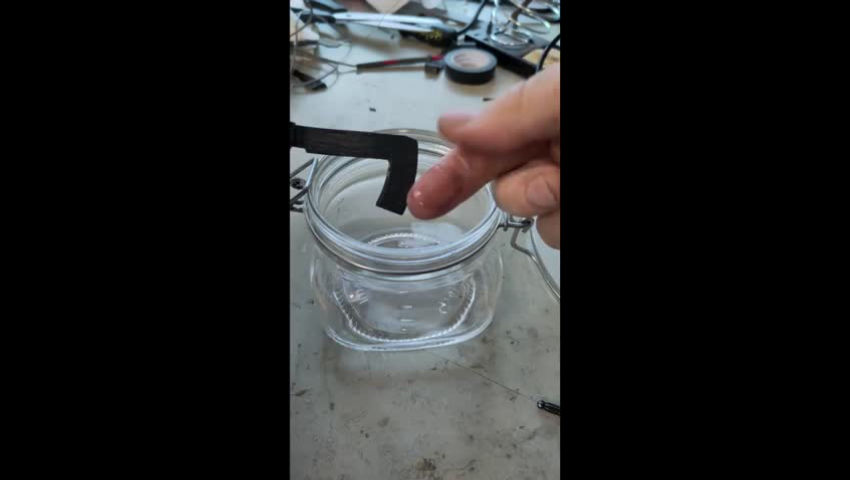
I’ll come back to it in 30 minutes and it’ll be a messy soggy half-dissolved thing. And it’ll be fully gone within the hour.
Interesting if that happens, but that seems to be caused by additives used by prusa in their filaments then, because from a chemical standpoint the crystalline structure of PLA is simply not dissolvable by acetone. It can cause swelling and delamination of layers, but not actually dissolve it (without additives that mess with the polymer chains)
deleted by creator
Since when does acetone dissolve PLA? For PLA one should use ethyl acetate or chloroform
Have you even tried it instead of talking out of your ass?
I use acetone to assemble PLA parts and polish them all the fucken time.
Sure you do.