And services can choose to only allow operating systems which don’t lie, have anti-tamper mechanisms, and authenticate themselves cryptographically. It has definitely been easy to spoof your identity in the past, but OP is talking about where we might be heading in the future. Since the laws about OS:es having to partially identify the user is so obviously useless in its current form, don’t you think the corporations and politicians who are pushing for it are going to keep expanding it when they get the opportunity?
ffhein
- 3 Posts
- 98 Comments
Joined 3 years ago
Cake day: June 14th, 2023
You are not logged in. If you use a Fediverse account that is able to follow users, you can follow this user.

 831·20 days ago
Then he said Arch Linux should implement it anyway because the law requires it. archinstall PR #4290
Well, it’s not “the law”, it’s your local law. To most people on the planet, it doesn’t apply any more than for example North Korea’s laws. As far as I can find, Arch Linux is not owned by a foundation or similar legal entity (i.e. which could have been located in California), but the lead developer appears to live in Germany.
Have you tried Vivaldi? Co-founded by one of the Opera Software co-founders, so perhaps not a surprise that it feels a little bit like classic Opera. I liked it a lot, but I have since switched to Firefox because I want to support the non-Chromium options while they exist.
When buying your first car, would you pay extra to get a worse car so you have to learn mechanics in addition to learning how to drive? :)
It’s definitely about finding the least bad printer if shopping the budget stuff, they all have issues as you say. Personally I think it’s best to buy the printer which is the least likely to have severe design and/or manufacturing flaws and focus on learning how to get good prints out of it. When you’re a complete beginner it’s difficult to know if your print turns out bad because you’re doing something wrong or if it’s caused by a hardware issue.
Creality made good printers in the beginning, i.e. original Ender and Ender Pro. They used high quality components and offered good value for money compared to what else what available at that time. However, when they had cornered a large part of the market and got known as the brand that made the best beginner printers, things started going downhill. They switched from Meanwell power supplies etc. to cheap noname components, quality control seemingly became non-existent, and they released several poorly designed overpriced printers (E.g. the E3v2 - my first printer - and everything with “max” in the name).
I think there’s a combination of different reasons for why there always have been so many people who believe that Creality make good printers:
- People who have bought their Ender 3/Pro before 2020 actually have good printers, and give them honest praise on forums.
- Fake reviews on the internet, which hype up the product since their only goal is for you to click their amazon affiliate link and buy it.
- Creality paying content creators for positive reviews, including several well known and otherwise respected within the community.
- Buyers who got lucky with the QC and don’t own any other printers to compare with, might think their printers are the best.
- Buyers who are now happy with their Ender after having spent €100+ on “upgrades” and/or days of troubleshooting the printer. I’ve even seen a guy insist that an Ender is a better first printer than a cheaper more reliable alternative, because the 20 hours he spent on his Ender to get a decent print out of it gave him “an invaluable learning experience”.
- And I’ve also seen people who haven’t yet bought any printer claim that Enders are the best beginner printers, just because they’ve read that statement so many times they’ve come to accept it as a fact, and now they’re “helping” others looking for a first printer by answering their questions.
I think my E3v2 is good now, but I’ve replaced the hotend, extruder and part cooling fans. I’ve added a second Z lead screw to fix gantry sag, and I found a manufacturing error where the X belt tensioner wasn’t straight because tightening the screw into the aluminium extrusion bent the plastic (difficult to find, but luckily easy to fix with a metal shim). I’ve replaced the firmware with Klipper, controlled by a Raspberry Pi. And I’ve probably spent at least 50 hours just trying to fix and improve the printer, which I didn’t mind btw, but I think most would prefer a printer which just works out of the box.
In retrospect, I wish I had joined some 3d printing discords and talked to experienced users before deciding on which printer to buy, and not relied so much on google, websites and random comments.
I don’t know about you, but lighting greatly impacts how the surface quality of my prints look. Hard/direct light at a steep vertical angle makes the faces look pretty rough, but more diffuse light coming from the side makes the parts look great.
It’s normal, but I think it’s more visible the thicker your layers are. I’ve also seen a respected 3d printing content creator use this effect to make his sponsored brand (Creality) look like it has higher print quality than the competitor… If you’re printing with ASA, perhaps you could use some light acetone smoothing if you want a more even surface?
 1·2 months ago
If you enjoy building the Voron that’s definitely a better deal (and I think I would) but if you’re doing it to save money you have to factor in that time in the cost as well. I was briefly considering buying a Core One L after they become available with INDX, because it would be nice with a printer which includes everything and just works. But the VFA problems discouraged me, Prusa’s suggestions to overtension belts and modified slicer profiles which try to avoid certain speeds feels like a bandaid solution to what is fundamentally a hardware design flaw IMO.
Can’t remember if it was Gnome 3 or Ubuntu Unity, but I think at least one of them had the intention of creating a unified UI for all types of devices.
Very important. I spend a lot of time at my computer and my desktop environment is like my home. I want it to look in a way that I find aesthetically pleasing and it mustn’t try to force me to change the way I work because some UX designer decided that their way was much better than everybody else’s. Perhaps you can guess where this is going :D but I’ve tried to like Gnome 3 since it was first announced. I’ve given it multiple chances but it just doesn’t work for me. It feels like they’re going down the same road as all “modern” UIs, where only the most basic features are visible and everything else is either dumped into the “advanced” category or removed entirely. On the other hand, I have a coworker who only uses his PC like a tool, and he thinks Gnome is the best DE ever and can’t understand why anyone would want something else.
Currently I use KDE and I’m pretty happy with it. It’s highly configurable, and I’ve made it look and feel the way I want. I used mainly Xfce for a long time but now I prefer KDE.
It’s funny if you know that it is parody, but it’s so widespead in this day and ago so I tend to unconsciously filter it out. Tbh I probably wouldn’t have clicked the link if I hadn’t seen your comment, since I thought this was the original title of the video
I think you missed the part where it said “[…] cannot be overridden or otherwise defeated by a user with significant technical skill.” I.e. either the printer will only allow flashing with signed firmware containing the detection algorithms, or it would have to be done by a separate chip which isn’t affected by flashing firmwares.
But also detecting firearms in gcode is a ridiculously complex task, and if companies actually try to comply they might opt for building the algorithms into their closed source slicer instead, and then only allowing their printer to print encrypted/signed gcode. Or they might do the analysis using some AI algorithm on their cloud servers, requiring an always on internet connection to print things. It might be tempting to think that nobody would buy a printer like that, but I think that enough people will do if they make it convenient and cheap enough.
For a printer to be compliant, it mustn’t be possible to bypass the restrictions. So your printer might not even be legal if it allows you to flash custom firmware.
identify and reject print requests for firearms or illegal firearm parts with a high degree of reliability and cannot be overridden or otherwise defeated by a user with significant technical skill.
I think a new Linux user shouldn’t have to choose a DE, so starting with a distro which makes this choice for them is most likely better. Unless the CachyOS installer does a good job at explaining what a desktop environment is, there’s a risk that a new user thinks they’re just selecting a skin for the OS and don’t understand how it will affect their desktop experience. If they for example choose an extreme light weight DE for their brand new gaming PC, their first impression of Linux might be that it looks dated.
Having a DE chooser built into more distro installers could be a good thing for us more experienced users though.
It’s also only the 50mm closest to X-axis 0 (left edge of bed I guess) that have significantly higher values, the rest of the bed is fairly even. Depending on what models OP has printed, they might not even be using this part of the print area.
If you set the UI to “simple” most of them are hidden, but it’s the best slicer for people who want a lot of options IMO :) I think it does a good job at categorizing and organizing all the different options, so it’s relatively easy to find whatever you’re looking for.
I think it’s more of an art form than an exact science to get perfect calibration using the paper method. It gives a decent starting point for further manual adjustment though. Personally I prefer to put a lamp behind the printer, and then babystep the nozzle down until I can no longer see any gap between it and the bed, but that also usually requires a few minor adjustments afterwards.
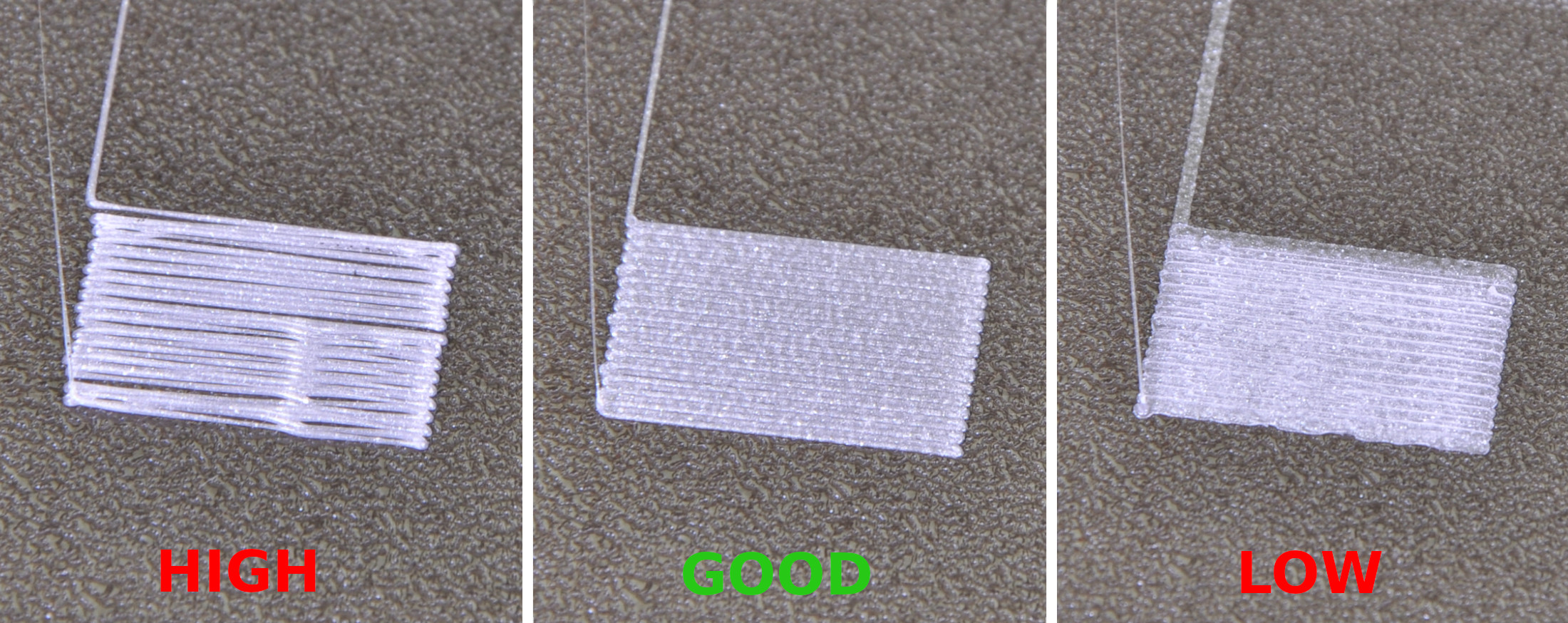
Looks better, but IMO it looks like it’s still calibrated too close to the bed. In some places it looks like the material has been smushed into the surface, and in others it looks like ridges have formed between the lines where the nozzle has pushed excess material around. https://cdn.help.prusa3d.com/wp-content/uploads/First-Layer-Calibration-04.jpg
If it wasn’t open, they would be violating the licences of the FOSS projects it’s forked from. Their firmwares inherit GPLv3 from Marlin, and CrealityPrint inherits AGPLv3 from slic3r (via Orca Slicer, Bambu Studio and PrusaSlicer).
These aliases for zsh I use all the time. It’s part of the prezto configuration framework.
setopt AUTO_CD              # Auto changes to a directory without typing cd.
setopt AUTO_PUSHD           # Push the old directory onto the stack on cd.
setopt PUSHD_IGNORE_DUPS    # Do not store duplicates in the stack.
setopt PUSHD_SILENT         # Do not print the directory stack after pushd or popd.
setopt PUSHD_TO_HOME        # Push to home directory when no argument is given.

alias d='dirs -v'
for index ({1..9}) alias "$index"="cd +${index}"; unset index
Type
dand enter to list all the directories you’ve recently been in, then type the number at the start of the line followed by enter to immediately cd there.Not sure if latest bash can do it the same thing, but some years ago I wrote a script to implement it there too. IIRC it might’ve been the automatic removal of duplicates in dir history that was missing.
I’d phrase it as “we might occasionally find workarounds that kinda work sometimes”. I tried running de-Googled Android on my phone for a while, and the only reason I could use it for online banking, pay for public transport, contact health services, etc. was because some people had reverse-engineered Google’s services (i.e. microG). It also stopped working every now and then when something changed, and to my knowledge Google could also shut it down instantly if they started encrypting their APIs. I wouldn’t bet on there always being workarounds if this push to lock down operating systems and online services continues.
Someone else posted something interesting/alarming the other day… With AI becoming more advanced and also more accessible, it’s going to be increasingly difficult to keep spam, scams, etc. at bay. If the mainstream computing world ends up in this gilded cage trap, even if a minority choose to maintain and use forks that stay outside the system, it might be quite difficult to keep for example a forum functional.