• 0 Posts
  • 26 Comments
Joined 3 years ago
cake
Cake day: July 5th, 2023

help-circle

  • The controller was working both Tower and Ground frequencies at the time of the collision. At a busy airport like LaGuardia, that’s incredibly unsafe, IMO. Something grabbing his attention on Ground distracted him from this developing situation on his Tower responsibilities, and that’s all it took. He tried to then stop it, but it was too late.

    He’s going to live with what happened for the rest of his life. I feel deeply sad for him. It’s not even really his fault. He was put in a situation where any human is likely to fail sooner or later.

    The US’s air infrastructure (along with a lot of other infrastructure) has been going downhill since the Reagan administration. The US needs a 2-3x investment in the FAA 10 years or so ago.

    I haven’t travelled to the US since Feb 2020, and I’m not going to (even for work) for multiple reasons at this point: the continued deterioration of the FAA’s systems is one major one.






  • I work primarily in “classical” AI and have been working with it on-and-off for just under 30 years now. Programmed my first GAs and ANNs in the 90s. I survived Prolog. I’ve had prolonged battles getting entire corporate departments to use the terms “Machine Learning” and “Artificial Intelligence” correctly, understand what they mean, and how to start thinking about them to incorporate them correctly into their work.

    Thus why I chose the word “LLM” in my response, not “AI”.

    I will admit that I assumed that by “AI” Jimmy Carr was referring to LLMs, as that’s what most people mean these days. I read the TL;DW by @masterspace@lemmy.ca but didn’t watch the original content. If I’m wrong in that assumption and he’s referring to classical AI, not LLMs, I’ll edit my original post.


  • TL;DR: Yes, you subsidize, because the amount each seat pays is proportional to their ticket price, but it’s a small amount per flight. But you also need to think about what you consider “fair” in this instance.

    Sorry, been offline for a few days. I’m curious, so let’s check the math:

    Their example is a flight from Atlanta to Orlando. The most common flight on that route is a Delta B757-2001. SeatGuru can provide us with the most common seating layout: 24 First class, 21 Comfort+, and 135 Economy.

    The tax that the NYT Editorial Board is looking at is mostly likely the 7.5% Passenger Ticket Tax, which is about 1/3 of total fees on a two-leg itinerary2.

    Looking at Delta’s fares for about two months out on randomly chosen dates in October, I see economy fares of about $270, economy plus at about $350, and first at about $570 (I tried to take a median, but it’s very approximate). Those fares are round-trip, so let’s cut them in half for $135/175/285. At 7.5%, the tax comes out to ~$10.13/13.13/21.38 per seat. That tallies up to $2156.40 when we multiply out by the number of seats, pretty close to the $2300 value the video claims, so I’m comfortable saying my numbers are “right enough” for the example.

    Depending on how one structures the ownership of their private jet, the equivalent tax for them is zero dollars (they are exempt).

    There are then taxes that both flights would pay on a per flight basis or based on fuel consumed. A private jet would pay proportionally more of those than a commercial airliner (due to the lower % passenger weight of total weight), but those are a small part of the total fees, especially for the commercial flight. (I’m seeing about $300 per plane, so I think NYT was counting some of those fees but not all, as they said that the private jet would be paying about $60 in fees).

    The problem with the whole “subsidizing” conversation is that it depends on what perspective you take. If you look at it on a person-by-person basis, then sure, each passenger on the commercial flight probably pays less than the passengers on the private jet (assuming 2 ppl or something).

    But FAA resources aren’t provisioned on a “per-passenger” basis, they’re provisioned on a “per-flight” basis, with some modifiers based on:

    1. Origin and destination airspaces: busier ATC spaces require more resources, and the gain for an additional resource is not linear because of handoffs;
    2. Size of plane: bigger planes do take up “more room” in the sky, and therefore tax the ATC more than smaller planes, plus they compete for larger runways, where smaller planes can use smaller runways at airports that have them;
    3. Distance flown: Planes that fly farther use more ATC resources en-route.

    Let’s be generous and say that our B757-200 takes 4x the ATC resources that the private jet does (I would bet the real factor is closer to 1.5-2.5x). So for a total of 5 units of ATC resource, 4 are used by the commercial jet, and 1 is used by the private jet.

    The commercial flight therefore pays $(2156.40+60)/4=$554.10 per ATC resource, and the private jet pays $60 per ATC resource. Equal distribution would be $(2156.40 + 60 + 60)/5=$455.28. So the private jet is receiving a “subsidy” of $455.28-60=$395.28 per flight.

    If we divide that subsidy over all of the passengers on the flight by fare, then we get about $1.81/2.34/3.81 based on seat class. That isn’t much of a subsidy per passenger, about 1.4% of your ticket price.

    But let’s think about the other side of the equation: Chartering a plane from Atlanta to Orlando costs about $12,5003. Taking on an extra $395.28 would be an additional 3.2% per flight, which is admittedly more than the 1.4% of the fare for the commercial passenger.

    And hold on… we are talking about passenger transport when we’re talking about both flights… so let’s look at how efficiently those FAA resources are used. Keeping that 4x factor for a flight of the same distance, we have 4 FAA resources spread over a flight with a capacity of 180, let’s assume 80% full for 144 passengers, using about 0.03 FAA resources/person. Now let’s look at the private jet, which recall uses 1 FAA resource for the same flight plan. Let’s be generous and assume 6 passengers. That’s 0.17 FAA resources/person. The commercial jet is more than 5x more efficient in its use of FAA resources.

    These are people who literally create complex corporate structures for their private jets just to avoid that 7.5% excise tax, AND they tend to have much more disposable income. I think they can pay the extra $400 for their inefficient use of FAA resources.

    If I were making the rules (which is absurd because not only am I not an expert but I am also Canadian), I would make the FAA fees per-itinerary filed with the FAA and incorporate three factors:

    1. Category of departing and landing airports4
    2. Takeoff weight of aircraft
    3. Itinerary flight path length

    The FAA has a whole section on their website about airport planning, so I would use that to figure out how to apportion these factors to best approximate the factors required for FAA resource allocation. I’m sure there are planners at the FAA that have this all broken down already.

    So yes, unless you get a super-discount fare, you are subsidizing private jets assuming that the fair apportionment of costs is based on how FAA resource capacities are planned. It’s not much per passenger, but it adds up across all of society, and is another way that the US economy moves wealth from the lower classes to the upper class.


  • As a percentage of the total weight of a plane, passengers and their luggage constitute a much larger percentage of a commercial flight than a private one. So they are “more utilized” than a private jet, and can spread that cost over all their passengers.

    Also, larger planes that fly longer distances cross more ATC zones, using up more ATC resources. They also take up more “room” in the sky, as e.g. ATC needs to leave more room for jet wash behind a heavy. So it makes sense from multiple perspectives that bigger planes pay more.

    You also have to consider hobby pilots. Charging them the same amount as a 747 would be insane.

    So it’s a tradeoff: the Canadian system makes smaller planes pay more, proportionally, than a per-ticket model; but not so much more that it harms the smallest personal planes.

    It’s also just simpler. Personal plane? Private jet? Commercial passenger flight? Cargo plane? Same calculation for all of them.

    (Yes, you could try to make it “only for flights with paid passengers”, but then pilots of private jets would all of a sudden have a lot of very rich friends with whom they do a lot of personal flying. It’s just so much easier if there’s nothing subjective about it.)


  • I don’t frequent that world much these days, but I personally preferred the agent/pull model when I did. I can’t really articulate why, I think I feel comfortable knowing that the agent will run with the last known config on the machine, potentially correcting any misconfiguration even if the central host is down.

    The big debate back in the day was Puppet vs. Chef (before Ansible/SaltStack). Puppet was more declarative, Chef more imperative.

    I also admit, I don’t like YAML, other than for simple, mostly flat config and serializing.

    I further admit that Ansible just has a bigger community these days, and that’s worth something. When I need to do a bit of CM these days, I use Ansible.


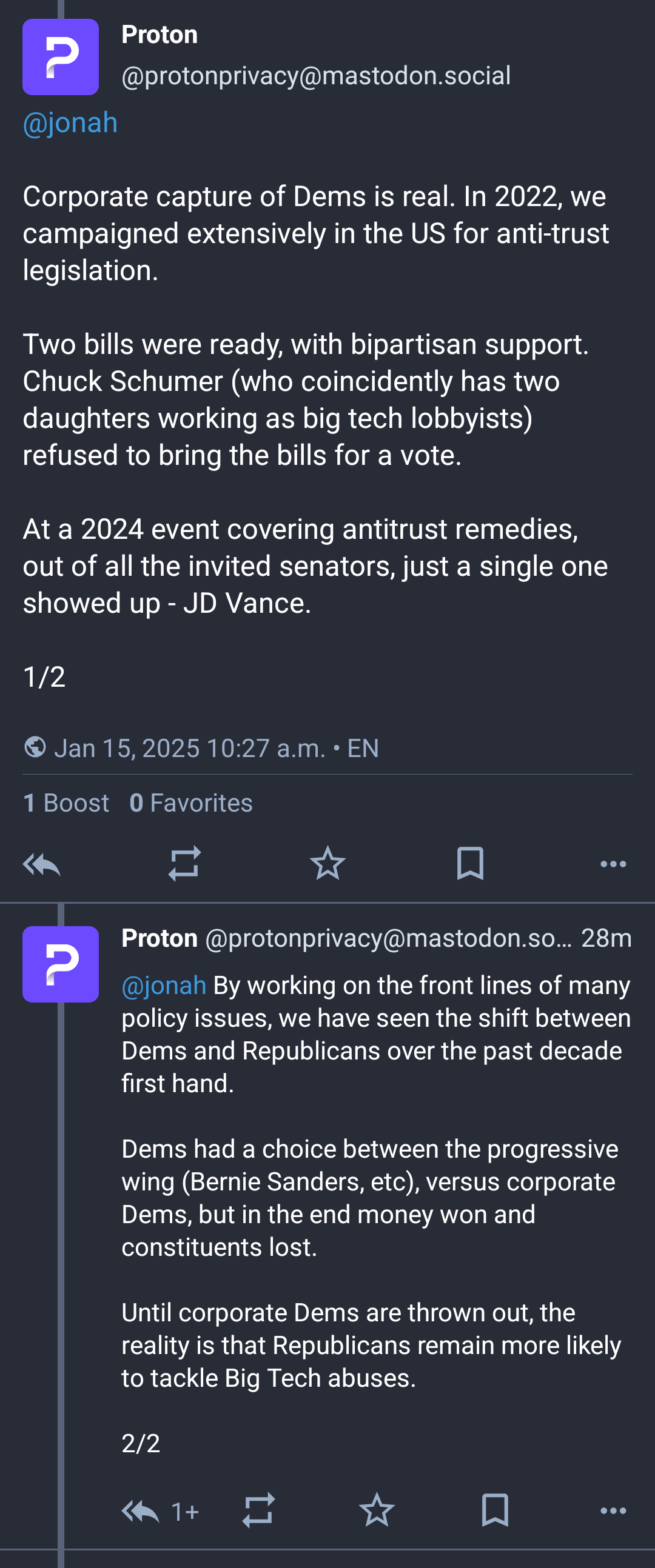
  • The official @protonprivacy@mastodon.social account replied and doubled down

    protonprivacy@mastodon.social - @jonah

    Corporate capture of Dems is real. In 2022, we campaigned extensively in the US for anti-trust legislation.

    Two bills were ready, with bipartisan support. Chuck Schumer (who coincidently has two daughters working as big tech lobbyists) refused to bring the bills for a vote.

    At a 2024 event covering antitrust remedies, out of all the invited senators, just a single one showed up - JD Vance.

    1/2

    protonprivacy@mastodon.social - @jonah By working on the front lines of many policy issues, we have seen the shift between Dems and Republicans over the past decade first hand.

    Dems had a choice between the progressive wing (Bernie Sanders, etc), versus corporate Dems, but in the end money won and constituents lost.

    Until corporate Dems are thrown out, the reality is that Republicans remain more likely to tackle Big Tech abuses.

    2/2

    (Less importantly, my response)


  • Technically, you’re correct. In this particular case though, I don’t think it’s the best kind of correct.

    Juries are the triers of fact when present. In a civil case, that means the judge can ask all kinds of nuanced questions in the jury instructions, as that could be necessary for the judge’s application of the law later down the line.

    In the US criminal justice system, the laws are meant to be interpretable by the common person (a lot of work being done by “meant-to-be”). A judge only asks them a single question: For the charge X, how do you find? Since juries do not need to justify their decision, they can use whatever reasoning they want to behind closed doors to reach their decision: facts, ethics, or flipping a coin. The lawyers use voir-dire to try to exclude jurors that would be too biased, or would be willing to use a coin flip (juries almost universally take their job seriously—they hold the freedom of someone in their hands.)

    As mentioned elsewhere, an acquittal by a jury in the US is non-reviewable. It doesn’t matter why they acquit. Convictions, OTOH, are reviewable, and judges have famously thrown out guilty verdicts from juries before.