
• 2 Posts
  • 237 Comments
Joined 3 years ago
cake
Cake day: June 29th, 2023

help-circle
  • This is just a statement of faith in your ability to judge these things accurately. Nowhere in here do I see any evidence that you’ve even considered that the reason you’ve changed your attitude towards the tech is that it’s just gotten so good at fooling people that it’s finally got you.

    You don’t gain much from trying to convince me, but you could gain a lot from being more sceptical. People invented science to address the fact that our intuitive understanding doesn’t always reflect reality.

    Science and the collection of objective data stops us from doing this:

    A three-panel illustration of a child with two water glasses on a table in front of them.  In the first panel, the glasses are identical and full.  In the second, someone is pouring one glass's contents into a tall thin glass.  In the third, the tall glass of water has replaced the glass that was poured into it, and the child is pointing to the tall glass to indicate they believe it contains more water.

    There are a bunch of things that our brains just don’t understand intuitively, so we need to check our intuition against measurement. There’s no shame in that, but when it’s pointed out, then you have a chance to check yourself.

    But you don’t seem to understand that. When you say:

    Anyway, you’ll see all this eventually, when some data gets published.

    you are demonstrating that you are the perfect mark for this stuff, because you are not reflecting on your own thought process to see where it might be failing you.


  • You’ve been given evidence that people cannot trust their own perceptions of what these agents do, and you replied by telling a bunch of stories about why you think you personally can trust your perceptions. My 12-year-old did the same thing when I tried to explain this to them.

    Engineers being spread thinner to manage a wider number of tasks whilst reviewing shitty LLM noise that they didn’t write is inevitably going to make horrible code that’s impossible to maintain and will cost massive amounts of time and resources in the long run.

    And the idea that it allows more things to be done is just a bunch of “it makes you faster” assessments in a trenchcoat.

    Agentic or not, they still have zero fidelity. Fidelity can only come from an internal model of reality that the network is comparing its inputs to, and I’m pretty sure you don’t get that without AGI.

    The data we have till this point shows that they don’t help, they only create an illusion of helping. And until you can show that that has fundamentally changed, then you have to assume that the improvements you’re seeing are just improved illusions.



  • whilst it is adding some productivity

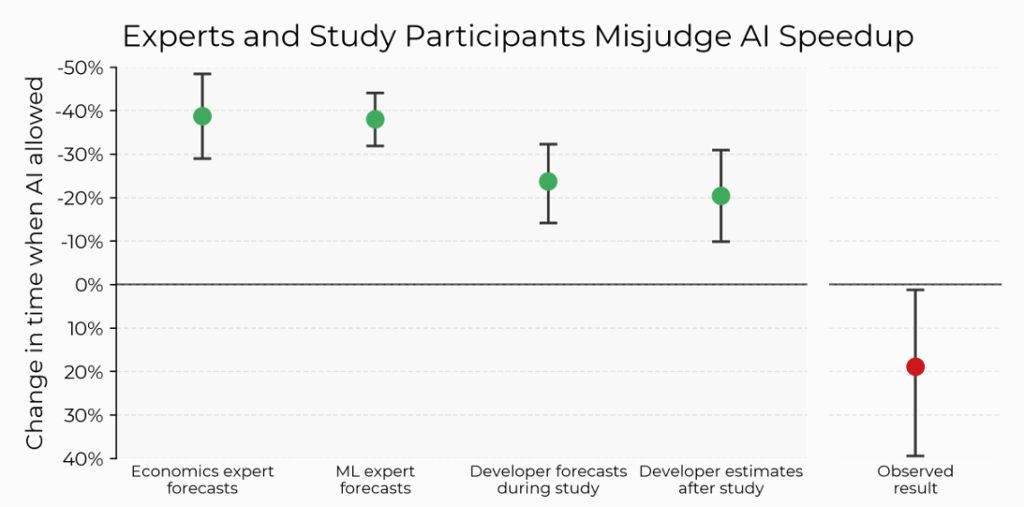
    Is it though? Like what’s the evidence of that? If it just feels like it must be true, I have some bad news about that:

    https://arstechnica.com/ai/2025/07/study-finds-ai-tools-made-open-source-software-developers-19-percent-slower/

    The most interesting part of this isn’t that it slowed them down when they expected to be faster, it’s that even after it slowed them down, they couldn’t tell and were fooled that they had been faster.

    Look at the graph, especially the last two lines:

    https://cdn.arstechnica.net/wp-content/uploads/2025/07/aicodingchart-1024x507.png

    My theory about this is that LLMs were tasked with giving useful output, but they couldn’t do that, because they have no fidelity, so instead they found a shortcut, which was to trick people into thinking they were being useful. They found the same loophole that conmen have used for millenia, and automated it. It’s the AI alignment problem, only for some reason people aren’t talking about it, maybe because they don’t want to believe that we’re this easily manipulated.

    There’s no reason to believe LLMs have gotten any better at actually doing useful work in the meantime in the absence of any objective measure of it. I think the best explanation for their “improvement” is that they have simply gotten better at fooling us.


  • It would be nice if you could post something where we can examine the source. (EDIT: the link has been changed since I wrote this)

    I found this article: https://www.techspot.com/news/108720-hidden-fingerprints-inside-3d-printed-ghost-guns.html

    There they say that it’s not yet ready to be used in evidence, but the problem with that is that most forensic “science” is generally misapplied and nowhere near as conclusive as the police want us to think. They can usually massage the results to tell a jury what they want to be true. That would be my concern with this kind of technique.

    Also, if you’re going to the trouble of making a 3d printed ghost gun that will be used in a crime, you could always hide the toolmarks with a sander. You could also treat the surface with resin which would make the markings practically unrecoverable. I’ve started doing both of these for my prints and I love the results just for the aesthetics, so it’s not such a stretch to imagine a gunsmith doing the same.


  • I think the special thing about this one is that it’s open source and you can build it from common components, which makes sense. You literally just need a stepper or servo motor with the correct algorithm and a few bits & pieces to apply that motor to the dial.

    It should be easy enough to build this for no more than a hundred bucks, maybe less if you can get cheap parts or you’re building more than one. It’s actually less complex than a basic 3d printer.

    The expensive part comes from the low volume production and the professional customers. Plus the software is probably proprietary. It takes expertise and to make a business out of that means high individual prices.

    So it’s really a perfect candidate for open sourcing.