
Licensing wasn’t exactly a thing I used to think about for the personal projects I create. I used to use Creative Commons and WTFPL almost interchangeably (the former for artworks, the latter for code), as if these were to mean the same “I don’t care about what you’re gonna do with this creation” (narrator voice: these didn’t mean the same thing).
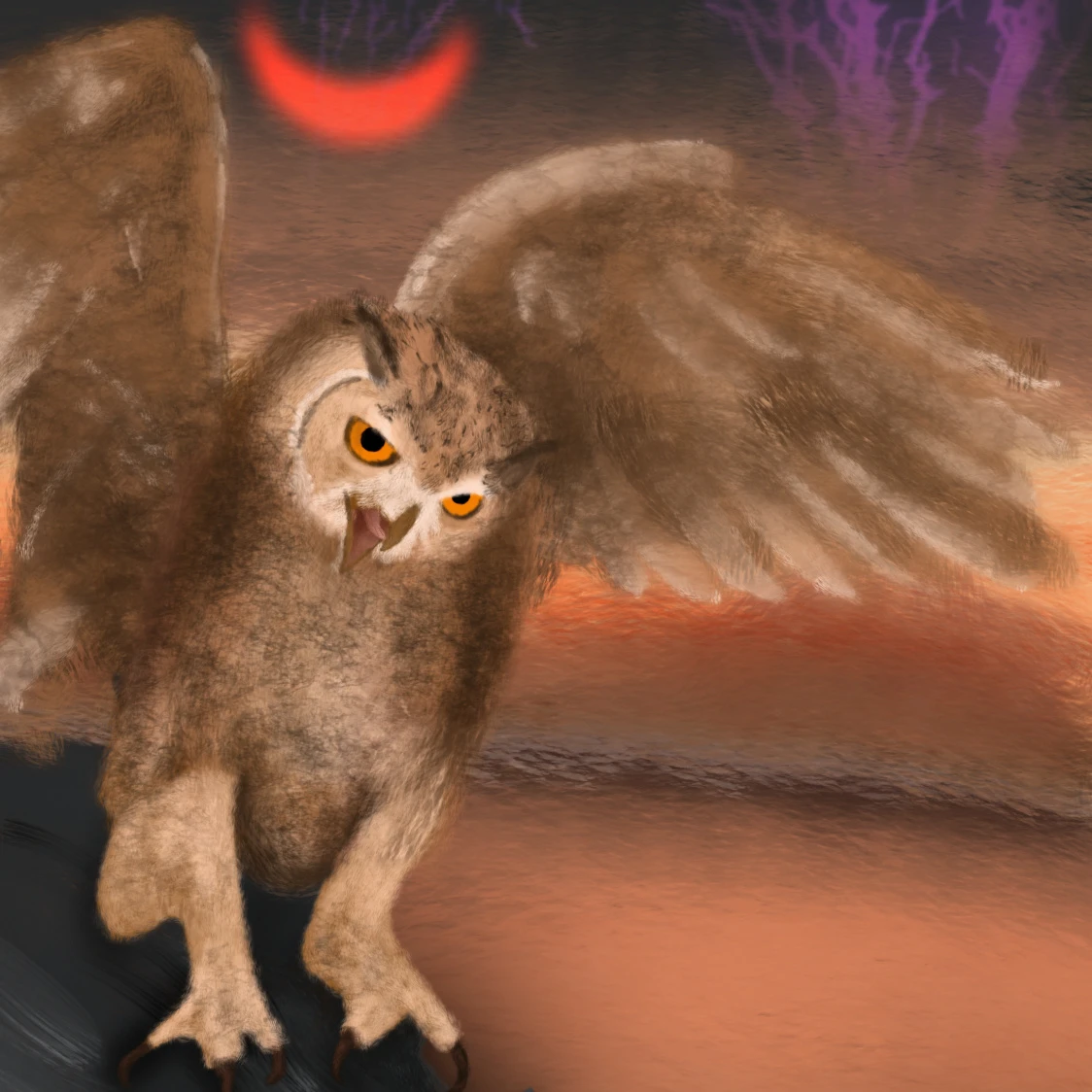
But, then, one aspect I’ve been thinking about for my ongoing project (doing a 3D model of a full, animatable owl I’ve sculpted from scratch in Blender), an aspect of which will likely influence other projects I happen to create after the ongoing one, is licensing.
To the one hand, I don’t want to require attribution, I don’t care about attribution precisely because I’m taking nothing with me after I die someday. Preferably, I’d want it to be part of Public Domain so every human and (who knows?) non-human living being could use it for free (even though I myself had my costs while creating the things I create, it’s important to me that I release my personal creations free of charge so these are affordable for anyone to use/modify/appreciate).
To the other hand, and this is a feeling that have grown more and more intense deep down inside me as the days pass (a hatred for capitalist greed exploiting the creations originally made and dedicated for free; a hatred for the exploitation of the means of artistic production), I don’t want projects deriving from and/or using this creation to be closed behind private property, I don’t want these to be put behind paywalls.
Originally, I’d be inclined to use CC0, as my initial thought was to dedicate my creations to the Public Domain (as all art and knowledge should be, IMHO), but then there’s the phenomenon in which a corporation (e.g. certain corporations with cartoonish rodent mascots) takes something from PD, does enough to be past the legally-required de minimis threshold for it to be copyrighteable, then close it behind paywalls and trademarks. And even though I’m just a random nobody, I do NOT want this to happen with my creations, I do NOT want this to happen more than I do not want to require attribution. I want it to stay free, free as in libre and, especially, free as in gratis (free of charge). I also want everything that ever makes use of it, as well as every derivative of it, to be free.
As far as I could research about this (especially as IANAL), I learned that, once I dedicate something to PD, reinforcing PD over the derivatives/uses is legally impossible (makes sense as there’s no such thing as a “Earthly Representative of the Public Domain Commons” to sue/punish every corporation daring to privatize something taken for free from the Commons).
It seems like I have only two major choices: I can choose between dedicating my creations to PD (and therefore waiving all my rights over these, including my future ability to sue whoever puts price tags and/or trademarks on top of the things meant to be free) and accept that a landlord can do past the de minimis to exploit these for corporate whims, or I can choose to keep some rights over these (particularly the attribution part) for me to have the legal means to enforce a share-alike licensing requiring the derivatives and projects using these to inherit the gratisness.
Are these my only choices, really? Is there something, preferably tested legally across jurisdictions, which I could use for my projects (especially for my ongoing 3D project once I feel ready to release it) to satisfy this will? Or it’s actually something impossible (enforcing gratisness)? If my current jurisdiction influences on the available choices, I’m Brazilian.
An attribution requirement isn’t enough to enforce a share-alike clause, it has to be there from the beginning.
You can select Wikipedia’s CC BY-SA license that requires to keep derivative projects under CC BY-SA. I don’t think CC SA without BY exists, but you can partially waive attribution requirements yourself as Wikipedia does this.
Also, for “free as in grantis” there is CC BY-NC-SA that explicitly bans commercial use, but I wouldn’t recommend it’s use as it’s not compatible with the orders of magnitude more popular BY-SA. A regular BY-SA license doesn’t prohibit from selling your or derivative works by another party, but it also allows everyone to legally “pirate” these works, so there’s little problem for the NC variant to solve.
BTW, any licenses imposing any restrictions can’t be called “public domain”, there are other words to describe them like “freely licensed”.
but it also allows everyone to legally “pirate” this work
The problem in this situation isn’t piracy, the problem is the content being contaminated by demiurgic capitalism. I would definitely be the first and main person to endorse piracy unto capitalism-exploited versions of the content I myself created. But this means a corporation have successfully transmuted something spiritually charged (i.e. something channeled through my creativity outlets as gnosis) into some kind of capitalist aberration for archonic whims, an enshittification of which…
A regular BY-SA license doesn’t prohibit from selling your or derivative works by another party
…is the main thing I (and likely Her as far as I’m aware of Her principles and True Will) do not wish to see happening to the fragments and shadows of spiritual energy being channeled/carried through my creations (and which would be inexorably imbued into derivatives, hence the requirement that derivatives follow the same principles of gratisness).
but I wouldn’t recommend it’s use as it’s not compatible with the orders of magnitude more popular BY-SA
Oh… you mean… CC-BY-NC-SA is yet to be tested legally, is it?
BTW, any licenses imposing any restrictions can’t be called “public domain”, there are other words to describe them like “freely licensed”.
Yeah, I mean, this makes sense… Even though the restrictions aim for humble creativity and artistic freedom, I can see how “enforcing freedom” may sound like a paradoxical/oxymoronic statement… but since archonic exploitation (greed) exists in this baryonic realm, and capitalism (esp. late-stage capitalism) won’t rest until all the earthly Commons get transmuted into adware and/or subscription-based products, freedom is a principle that must be fought for, especially through cultural and religious means (counterculture and Left-Hand Paths, respectively). I can’t help but notice how the Public Domain and the egregores of Libre knowledge as a whole are under attack, hence the need for enforcement of the freedom…
You seem to have a very uncommon system of religious/spiritual beliefs I, as most people, are not really aware about. You probably should have prefaced your post with explanation of who is “Her”, ”Her principles”, how channeling of spiritual energy works and a link to description of ideas and/or dogmas behind this teaching in some neutral encyclopedia. We can only help you with concerns phrased in a way a secular person can understand.
Oh… you mean… CC-BY-NC-SA is yet to be tested legally, is it?
That’s not the main concern, legally they all seem to work. The problem is, a person cannot make one derivative work based on two works, one under BY-SA, one under BY-SA-NC, as these licenses are requiring different conditions for derivative works. And BY-SA has a significantly larger body of works already under it. Popularizing NC increases license fragmentation and harms future derivative interoperability. SA already protects sufficiently against most predatory copyright privatisation.
The list of commercial usages that NC theoretically prohibits includes, for example, collecting monetisation from a blog with this work posted or drawing it on a hand-made craft that would be sold in an indie shop.
You probably should have prefaced your post with explanation of who is “Her”
“Her” is Dark Mother Goddess, Lilith among many names I believe She manifests as. I follow no specific religion but a solitary, independent syncretism whose concepts stem from several Left-Hand Paths. It’s mostly stemmed from gnosis, so I got no known source to point at that could define my current beliefs, but many concepts share the same original definitions: “gnosis” and “channeling” being “learning and/or being inspired by spiritual entities, often during altered states of consciousness”, and Lilith/Lilitu being the powerful Mesopotamian Goddess depicted in the Burney Relief, flanked by owls while also having owl traits Herself (hence part of why my artworks often revolve around owl symbolism; I don’t just find owls cute and awesome, for me, owls are one of the manifestations of the Goddess), sometimes paired with Lucifer (a more known name whom I also venerate to a lesser extent) as Her complementary in some LHP where both are known for, among other principles, forbidden knowledge, rebelliousness and untamed defiance (part of what I meant by “Her principles”).
But notice how the earlier paragraph trying to summarize my beliefs is lengthy, hence why I tried not to preface my post with my religious beliefs (because the way I communicate myself is already lengthy unto itself; also to avoid committing proselytism), still I had to nod at the spiritual aspects of my question mainly for contextualizing that there are personal religious reasons (seemingly an important factor for legal disputes in some jurisdictions, including mine, Brazil) beyond just political-ideological orientation behind both my artistic expressions and the principles I’m looking for in a licensing template.
The problem is, a person cannot make one derivative work based on two works
I tried to search for existing mixed licensing situations as soon as I saw your reply and… oh!.. I caught myself inside an A. cunicularia hole, so many things I wasn’t aware of!
To the one hand, yeah, Creative Commons licenses don’t always play nice with each other (remixing), with CC-BY-NC-SA being the 3rd most restrictive among Creative Commons licenses, and there are uncertainties regarding institutional usage. To the other hand, CC-BY-SA does neither prevent, say, a BlendSwap (where there are CC-licensed and even CC0/PD models made by artists for artists, but also an exclusionary “Plans” page) from charging users for downloading a model meant to be gratis, nor prevent them from omitting external links to the artist’s own sources where anyone could get it for truly free. Now I’m left with more legal uncertainties than solutions to satisfy the strict-gratisness plus forgiven-lack-of-attribution-by-individuals principles for best affordability by anyone without rendering it paradoxically unaffordable 😅.
The list of commercial usages that NC theoretically prohibits includes, for example, collecting monetisation from a blog with this work posted or drawing it on a hand-made craft that would be sold in an indie shop.
The first case, for me, would be okay if said blog weren’t to exclude other people from accessing because they can’t afford paying for access; if, say, the blog/website were donation-based with donations being totally optional (like Wikipedia), that would be perfectly okay for me because it’s the only monetization model I advocate for (and I made my donations to certain projects back when I was still employed, so it’s not utopia). The second case, definitely a no-no, as it involves something (or its derivation) through which I, the original creator, actively refrained from profiting (even despite the costs I had doing it, costs of which I absorbed to myself so anyone could access it freely), being put behind a paywall (“shop”) by someone else; I mean, that would be perfectly okay for me if the artist were to use my creation for their drawing while simultaneously asking for Ko-fi/etc donations, considering the derivative still gets to be shared free of charge despite someone not affording to donate to them.
CC-BY-SA does neither prevent, say, a BlendSwap (where there are CC-licensed and even CC0/PD models made by artists for artists, but also an exclusionary “Plans” page) from charging users for downloading a model meant to be gratis, nor prevent them from omitting external links to the artist’s own sources where anyone could get it for truly free.
It does require attribution though. You can request a link to be a part of attribution. CC BY-SA license, §3.a.1.A:
If You Share the Licensed Material (including in modified form), You must:
-
retain the following if it is supplied by the Licensor with the Licensed Material:
I. identification of the creator(s) of the Licensed Material and any others designated to receive attribution, in any reasonable manner requested by the Licensor (including by pseudonym if designated);
II. a copyright notice;
<…>
V. a URI or hyperlink to the Licensed Material to the extent reasonably practicable;
I highly recommend reading both licenses in full before considering applying them to your work.
The first case, for me, would be okay if said blog weren’t to exclude other people from accessing because they can’t afford paying for access
If you post an NC-derivative work on YouTube or a similar blogging site, and the platform has ads or sponsorships, and the creator gets a cut of ad revenue via a monetisation program (55% on YouTube), you are violating terms of the variant. I’m not a lawyer, but I believe that even if you are not in the monetisation program you still can’t post BY-NC-… derivative works on YouTube per their terms of service because if YouTube would make even a cent from a video or a post with it they would violate this license.
The second case, definitely a no-no
Well, physical items can’t all be free as they require limited materials to craft (wood, fabric…) and, unlike digital goods, can’t be duplicated indefinitely. Nonetheless, BY-SA would allow everyone to make a copy of the product as close as they would like with their own materials, using monetary investment one entrepreneur poured in to everyone’s most benefit.
I’m not aware of a license, a fortiori a decenly popular one, that would permit ubiquitous monetisation and forbid selling of a derivative work in any form.
-
the word you want to look for is copyleft. For Softeare there is the GNU GPL, Icm sure there is an equivalent for creative works.
Can’t edit my last answer, so here it is: Edit looks like Creative Commons has a licence for you [here](https://creativecommons.org/chooser/
When it comes to Creative Commons, the “SA” and “NC” seem to require a “BY”, an attribution of which, if possible, I’d like to avoid as I don’t really care about having my name attached to the things I created (also, there are spiritual reasons for me to prefer not having the signifiers of my mundane embodiment being strongly tied to artistic expressions stemming primarily from gnosis and
theophanicdeaphanic manifestations, as it would hinder my ego-dissolution endeavors).And, then, there’s the gratisness aspect (i.e. pertaining to or having the quality of being free of charge). Because, for example, when it comes to the GPL (even though I’m very fond of GNU Foundation and their freedom principles, most of which I share), there’s explicitly something along the lines “When we speak of free software, we are referring to freedom, not price” which feels, to me, like a major loophole in which someone or some corporation (particularly librewashing corporations) can release the “sources (several asterisks and tiny letters)”, not without lots of deliberate mechanisms to make the thing hard to use from the sources, while putting a price tag on the ready-to-use thing, even worse, tying it to a monthly subscription.
When it comes to my own creations, I wish to grant 'em both gratisness and libreness to these, but especially the gratisness part. I mean, I built an entire 3D character from scratch all by myself precisely because I was faced by non-gratisness (paid art) while being an unemployed person, and I do not wish the same on others whose realities are, like mine, incompatible with buying things as if paying for things were a trivial thing to be done.
I want people from all economic backgrounds to afford accessing my artistic creations, from a person living in a Brazilian comunidade (who may afford access to a simple yet 3D-capable computer (like the old laptop I have), theirs or communities’, but can’t afford buying things for composing the artistic expression) all the way to even the bourgeois (considering they use it for hopefully converting themselves spiritually into being less capitalistic/greedy and more humble as they let go of their archonic/demiurgic egos).
I’m afraid these licenses (GPL or CC) don’t really cover this specific principle I’m looking for, hence my initial question, regarding licenses in which the gratisness could be somehow guaranteed for a creation and its derivatives/uses, with legal instruments available as worldwidely as possible to curb corporations from exploiting it.
The license they’re looking for may not exist at all, but at the very least doesn’t exist within the Creative Commons world. They specifically don’t want attribution back to them to be required, and attribution at minimum is part of all the ‘traditional’ CC licenses. Deselecting attribution from the CC chooser forces you into a public domain license, which will allow anyone to do commercial stuff or charge for it, the other thing they don’t want.
You can select a license with attribution attached, but put in your project info that you have no plans to ever enforce the rules of attribution but will strictly enforce the rules of open availability and free of charge.
No one will enforce rules for you that you as project owner/creator does not care about.
No one will enforce rules for you that you as project owner/creator does not care about.
Exactly… And this seems to be also the problem when dedicating something to PD (Public Domain), as there’s no legal way for anybody, not even the person who created and dedicated their creation to PD, to enforce derivatives and uses to be also dedicated to PD and/or shared free of charge like the original creation was.
I was thinking about dedicating my creations to PD because I believe art and knowledge (and gnosis) shall be accessible by anyone, anywhere, anytime, with said accessibility being, to me, inseparable from gratisness, otherwise it wouldn’t be truly accessible, especially by those who can’t afford paying. Given how the main raison d’être guiding me through my spiritual-personal artistic expression has essentially been strict principles against capitalist exploitation, the gratisness aspect of my creations and its derivatives is, to me, the more important aspect, moreso than my spiritual preference not to be nominally remembered (and/or being conjured/evoked post-mortem) through my creations.
You can select a license with attribution attached, but put in your project info that you have no plans to ever enforce the rules of attribution but will strictly enforce the rules of open availability and free of charge.
Thanks for this idea. Yeah, seems like the only legally feasible way for me to (try and) enforce this gratisness, using CC-BY-NC-SA (or similar licenses) alongside a disclaimer easing the “BY” aspect… Although the “NC” seems not enough to me given how capitalist exploitation can come in disguised clothes, loopholes of which the NonCommercial aspect of Creative Commons couldn’t possibly curb, but then there’s the legal feasibility of having something deeper than the NC statement.
While I’m still open to suggestions with this thread, seems to me like this suggestion of yours is the most (the only?) legally-feasible option.
